
EXTINTION

Bologna, 2020 — Teatro Romano / ART CITY Bologna
In 2020, I was invited by Xabier Gonzalez Muro to take part in Extinction, a group exhibition curated by Gonzalez Muro and Michela Barausse at the Teatro Romano in Bologna, during Arte Fiera and as part of the ART CITY Bologna programme.
That invitation meant something to me that went beyond simply taking part in an exhibition.
I had been photographing for many years and had already exhibited my work,
yet I continued to question its value and whether it could genuinely find a place beyond the photographic circles I had been part of until then. The fact that another artist had looked at my images and recognised something worth bringing into that project made me think, perhaps for the first time with a certain conviction, that the research I had been pursuing could have a different dimension.

Extinction addressed the fragility of the relationship between humanity and nature, and the possibility of loss.
For the exhibition, I selected images made at different moments in my research, mainly between 2011 and 2019. I did not want to create a catalogue of endangered species, nor did I want the message to rely solely on the rarity of the subjects.
I was interested in using photography to alter their presence, changing our perception of scale, movement, space and even the physical consistency of the image itself.

In one photograph, a group of pink flamingos emerges from the fusion of five exposures, each made using a slow shutter speed. Their bodies overlap and lose definition as movement becomes part of the image. What I was looking for was not a description of the individual animals, but a sense of the collective movement of their courtship.

In another image, an Italian deer emerges from the mist. Its presence remains recognisable, yet it seems on the verge of dissolving into the space around it.

With the aerial photograph of a whale, I explored a paradox of scale. The animal — a female approximately twenty-two metres long, accompanied by her calf — appears tiny within the immensity of the sea.
One of the largest animals on the planet suddenly becomes a fragile presence in a seemingly measureless space.

With the yellow-bellied toad, I did the opposite. An animal only a few centimetres long, whose conservation status in Italy is critical, is rendered through a large and evanescent image. Its real dimensions disappear, and a presence that would normally be almost invisible occupies a space it could never possess in nature.

The tree was also part of this reflection.
A solitary elm in the plains did not represent a rare species, but something equally fragile:
the presence of the tree within a landscape continually transformed by human intervention.
A slightly cyanographic tone, the snow and a few flakes suspended in the air isolated the subject, placing it in an uncertain state, almost poised between presence and disappearance.
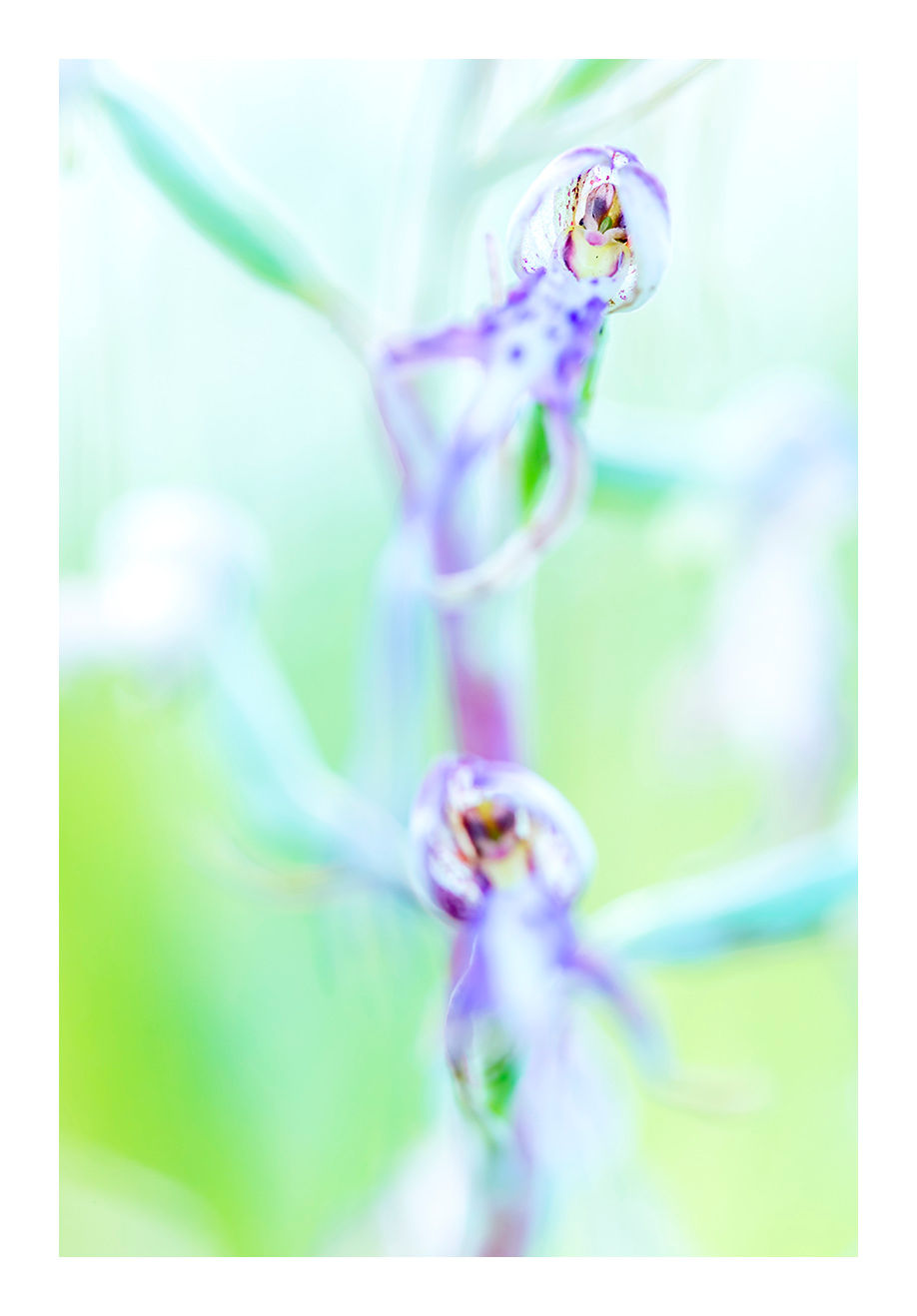
Looking at those images today, I realise that Extinction already contained something that would continue to accompany my work.The subject was still clearly recognisable, but simply showing it was no longer enough.
I needed to transform the way it was perceived.
Scale could be reversed. Movement could dissolve a form. An enormous animal could become small; a tiny creature could occupy the entire image; a real tree could suddenly find itself in a space that seemed to belong nowhere.
At the time, these choices were primarily connected to the theme of the exhibition. Looking back today, I can also recognise in them a question that had already been running through my work for years and would continue to resurface:
How much can what we know change when we change the way we look at it?

This is why Extinction remains an important moment in my journey.
Not because it marked the beginning of my photographic research, whose roots go much further back, nor because my path suddenly became linear from that point onwards.
It was, rather, a moment of recognition.
Someone had looked at my work from the outside and decided to invite it into an artistic context that, until then, I had mostly observed from a distance.
And for the first time, I began to think that perhaps what I had been searching for through photography for so many years could become something more than a private investigation.


Commenti